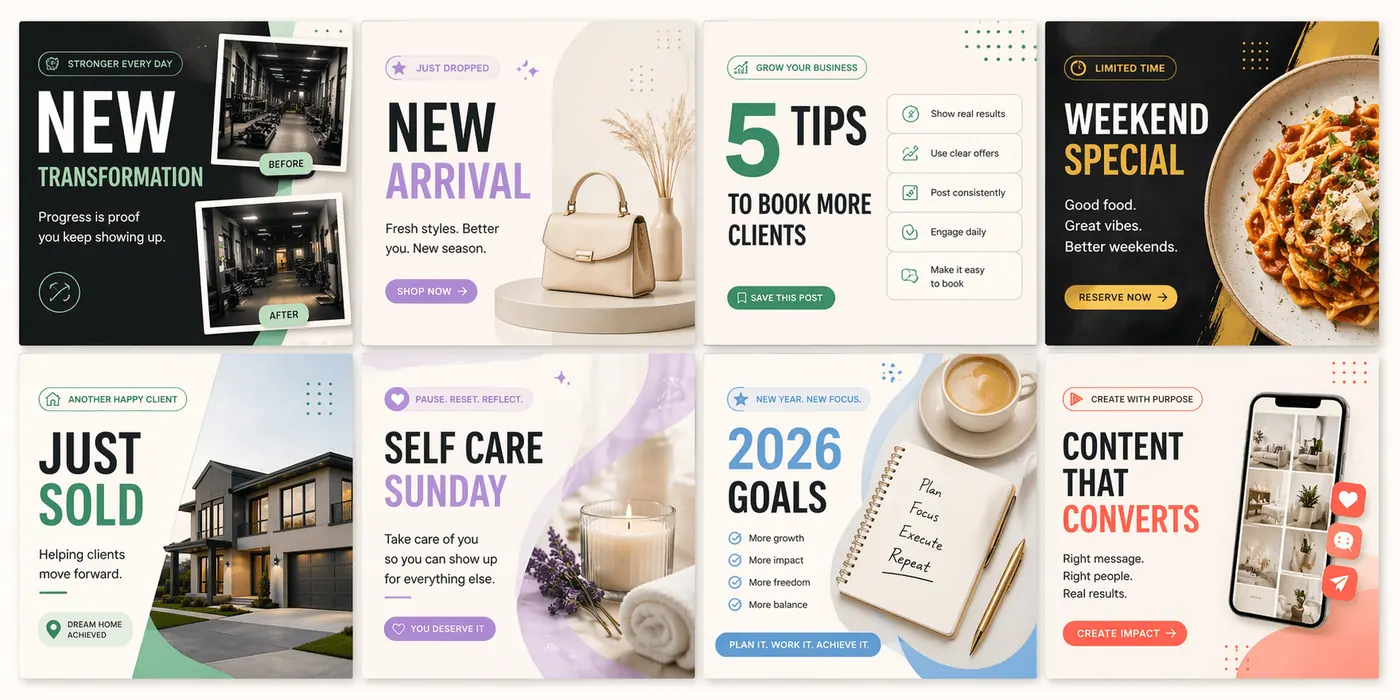
Buying guide

Facebook posts for small business offers and local promotions

The buyer needs posts that are easy to understand in a local feed and reusable for groups, pages, and ads. This guide helps small businesses that still rely on facebook for local reach evaluate the scope, prepare the right source material, protect approval control, and decide whether the service fits the way the business needs to publish.

Check the missing detail Build a 5-post outline Read the guide See when to hand it off

Use this guide

How should you use this before choosing a content path?

Start with the buyer decision, collect the real inputs, adapt the category example, and check the sequence before choosing who should produce it.

01 / Diagnose

What is the buyer trying to decide about Facebook posts for small business?

Narrow the page around the buying path, required inputs, editable zones, scope limits, and the difference between DIY and done-for-you setup. If the article cannot name that decision, it will feel like generic inspiration instead of a guide.

Use the audit
02 / Prepare

Which real inputs are ready before production starts?

Collect real photos, offer facts, brand details, CTA language, and honest source material supplied by the buyer. Missing facts should be resolved before the layout or caption creates pressure to guess.

Check the inputs
03 / Adapt

Which real details show that the proposed scope fits this buyer?

Start from this concrete situation: For Facebook posts for small business, define the scope first: local promotions, event reminders, appointment openings, specials, and service announcements. Then gather the real inputs: business photos, offer details, event dates, customer proof, service area, and link or message CTA. Keep the finished content focused on one next step: message, call, book, RSVP, order, or request details. Replace the example details with current, approved business facts.

See finished examples
04 / Sequence

What should the next post answer after this one?

Build a short sequence where each asset answers a different question so the business can pick the fastest path without overbuying or under-scoping the work.

Use the plan
05 / Choose

Should your team keep producing this or hand the posting system to Lumora?

Choose the path that can stay consistent. Keep production in-house when the team has time and clear ownership, or use Lumora when planning, creative, approval, and publishing need one accountable workflow.

Get a personalized plan

Reader usefulness check

Which details make the advice worth acting on?

Use these checks before you choose a layout, write a caption, select a service, or brief a designer. If the answer is vague, the finished content will usually feel vague too.

Offer clarity

Can a stranger understand what is being offered, who it is for, and what to do next without reading the whole caption?

A reader searching for Facebook posts for small business is usually close to action, so unclear offer language makes the page feel like inspiration instead of help.

Use this answer as the headline filter. If the offer cannot be explained cleanly here, the post should not move into design yet.
Proof strength

Which real details show that the proposed scope fits this buyer?

Readers trust specific source material faster than polished claims, especially when they are comparing whether the business can deliver.

Use the answer to select from real photos, offer facts, brand details, CTA language, and honest source material supplied by the buyer. The graphic and caption should make that evidence easy to understand.
Reader friction

Does the content resolve the main concern: whether Facebook posts can still drive local action without feeling outdated?

A useful post should remove one hesitation before it asks the reader to act, not simply repeat the offer in a prettier layout.

Turn that hesitation into one short answer before asking the reader to message, call, book, rsvp, order, or request details.
Action path

Is there one next step repeated across the sequence?

Curious readers need one obvious path after the guide. Multiple CTAs can make even strong content feel unfinished.

Keep the CTA consistent across the batch so every asset points toward the same measurable action.

Campaign playbook

How do you turn this guide into assets buyers can act on?

Turn the buyer's high-intent search for Facebook posts for small business into a scoped content decision with real inputs, a clear CTA, and a checkout path.

Use this when small businesses that still rely on facebook for local reach are comparing content help and need to understand what to send, what gets created, and why a focused package can move faster than a broad retainer.
01

Intent answer

Answer the search query directly and explain which business situation makes the service worth buying.

Choose the content path
02

Input checklist

Show the buyer exactly which source material supports the buying path, required inputs, editable zones, scope limits, and the difference between DIY and done-for-you setup before production starts.

Prepare the brief
03

Proof and scope post

Clarify that the work uses real photos, offer facts, brand details, CTA language, and honest source material supplied by the buyer instead of invented claims or generic filler.

Send real details
04

Plan bridge

Move the reader from research into the relevant monthly plan, focused pack, service page, or customization path.

Compare posting plans

Useful structure

How should you use a practical 5-post plan?

Use this structure as a working outline before you choose a service, request customization, or send a brief. Each post has a different job, but the same offer and CTA stay clear.

01

Buyer question

Answer why local promotions, event reminders, appointment openings, specials, and service announcements matters before asking anyone to buy.

Show
local promotions, event reminders, appointment openings, specials, and service announcements
Caption job
Name the customer situation, explain the fit, and point to message, call, book, RSVP, order, or request details.
CTA
See if this fits
02

Proof post

Make the offer feel specific enough to trust.

Show
business photos, offer details, event dates, customer proof, service area, and link or message CTA
Caption job
Explain the real detail in plain language and avoid claims the business cannot support.
CTA
Send the details
03

Objection answer

Handle the hesitation around whether Facebook posts can still drive local action without feeling outdated.

Show
A short FAQ, process note, comparison point, or customer decision checklist
Caption job
Answer one concern directly, then repeat the next step without adding a second ask.
CTA
Ask before you book
04

Timing reminder

Connect the post to a real buying moment: The buyer needs posts that are easy to understand in a local feed and reusable for groups, pages, and ads.

Show
A deadline, availability window, service area, launch date, booking slot, or ordering path
Caption job
Make the timing practical so the reader knows why acting now helps.
CTA
Take the next step
05

Final CTA

Bring the sequence back to message, call, book, RSVP, order, or request details after the useful context has been shown.

Show
Facebook-ready graphics and captions that explain the local action
Caption job
Summarize the offer, repeat the proof, and make the action easy to follow.
CTA
Create Facebook-ready posts

How do you decide what the buyer is really purchasing?

When comparing Facebook posts for small business, start with the actual outcome: Facebook-ready graphics and captions that explain the local action. The production scope behind that outcome is local promotions, event reminders, appointment openings, specials, and service announcements. If a provider cannot explain both in plain language, the buyer cannot tell what will be finished and what will remain on the owner's task list.

The value is not a pile of generic graphics. It is a repeatable path from approved business facts to usable content, a clear review step, and a publishing action that supports this goal: message, call, book, RSVP, order, or request details.

How do you match the content to the buying moment?

The buying context matters. The buyer needs posts that are easy to understand in a local feed and reusable for groups, pages, and ads. The proposed content should address that situation directly instead of forcing the business into a generic posting formula.

Use the intended destination as a practical check: Facebook pages, groups, and cross-posted Instagram content. Each asset should fit how people consume content there while keeping the offer, proof, and next step consistent.

What should you send proof before asking for polish?

Prepare the source material before judging visual polish. For this topic, that means business photos, offer details, event dates, customer proof, service area, and link or message CTA. These details make the work specific and prevent the creator from guessing about claims, prices, dates, service areas, availability, or offer terms.

A smaller batch built from current evidence is usually more useful than a large batch of recycled captions. Ask the provider to show which input supports each important statement and how missing facts are handled before approval.

How should you use captions to remove the main objection?

The main concern is whether Facebook posts can still drive local action without feeling outdated. A strong example, proposal, or service page should answer that concern in direct language before asking the buyer to commit.

The visual can make the offer noticeable, while the caption explains the detail that reduces hesitation. The finished content earns its place when a customer can understand the value, see relevant proof, and follow one next step without a long back-and-forth conversation.

How do you give the reader one useful takeaway?

Use a short evaluation sequence. First, confirm the scope: local promotions, event reminders, appointment openings, specials, and service announcements. Next, verify the available inputs and review an example of the intended deliverable: Facebook-ready graphics and captions that explain the local action. Then confirm who approves the work and where it will be published.

If any of those answers are vague, resolve them before paying for more volume. A clear small scope is easier to review, measure, and improve than a larger package with uncertain ownership.

How do you make the next click feel like progress?

A reader comparing Facebook posts for small business may need a finished example, a source-material checklist, a plan comparison, or a direct checkout path. Match the link to the unresolved question instead of sending every visitor to the same broad page.

Progress means the buyer understands the work, knows what to provide, and can choose this next step with confidence: message, call, book, RSVP, order, or request details.

Which useful examples can you adapt?

These are not fake captions to copy word for word. Use them as structure, then replace the proof, timing, and CTA with real business details.

Buying guide scenario

For Facebook posts for small business, define the scope first: local promotions, event reminders, appointment openings, specials, and service announcements. Then gather the real inputs: business photos, offer details, event dates, customer proof, service area, and link or message CTA. Keep the finished content focused on one next step: message, call, book, RSVP, order, or request details.

Replace every detail with the current business facts, then keep only the evidence needed to message, call, book, rsvp, order, or request details.

Proof-led hook

Before comparing providers, collect the evidence the work will depend on: business photos, offer details, event dates, customer proof, service area, and link or message CTA.

Use one approved photo, screenshot, review snippet, service note, or offer detail, then explain why it matters for the buyer decision.

Objection-answer hook

Answer the main concern before presenting the next step: whether Facebook posts can still drive local action without feeling outdated.

Turn the caption into a short answer with one proof point and one CTA instead of trying to sell every benefit at once.

FAQ

What should you know before you build this content?

What should Facebook posts for small business include?

It should include a clear scope, real business inputs, finished graphics, matching captions, an approval process, and a defined publishing destination. The package should explain what is custom, what the buyer must provide, and how it supports this next step: message, call, book, RSVP, order, or request details.

How do you keep a low-cost content package from looking cheap?

Keep the scope believable, use real photos and details, write captions for one buying action, and avoid promising more assets than the price can credibly support. Specific content feels more valuable than inflated volume.

Should this be one post or a full sequence?

Use one post only when the offer is simple and already familiar. Use a sequence when the buyer needs proof, timing, details, objections answered, or several reminders before taking action.

When should I use Lumora instead of handling every post internally?

Use Lumora when the business has real photos, offers, services, and calls to action but needs one repeatable workflow for planning, creative production, approval, and publishing. Keep it internal when your team already has the time and ownership to maintain that workflow.

Where Lumora fits

When should you let Lumora build this instead of doing it yourself?

Use the guide when you want the thinking. Use Lumora when the useful structure is clear, but the posts still need to be written, designed, and made ready to publish.

You have the facts, but no finished posts
Your move

Gather real photos, offer facts, brand details, CTA language, and honest source material supplied by the buyer, then choose the strongest offer and CTA before editing anything.

Lumora move

Lumora can turn those inputs into a personalized monthly plan with finished graphics, captions, approvals, and scheduled publishing.

The offer still feels too broad
Your move

Use the audit above to narrow the content around the buying path, required inputs, editable zones, scope limits, and the difference between DIY and done-for-you setup.

Lumora move

Lumora uses the business intake to clarify the angle before production so the monthly plan does not become generic filler.

You need a reliable publishing rhythm
Your move

Choose a realistic cadence and define who approves facts, offers, and creative before each post goes live.

Lumora move

Lumora can organize supported comments, messages, and reviews for approval-first routine replies on Growth, then add authorized qualification prompts and owner handoff on Autopilot. Sensitive support, disputes, refunds, crisis communication, closing, paid ads, and guarantees remain outside the standard scope.

What should you do after the guide makes the direction clear?

Keep using the outline internally if your team owns the calendar. Choose Lumora when you want the business analyzed, the posts created, the approval organized, and supported profiles kept on schedule.

Get a personalized content plan